
Satir Model (STST) Clinical Certification Endorsed by The Virginia Satir Global Network®
The Virginia Satir Global Network® (VSGN) is proud to offer a professional Certification in Satir Transformational Systemic Therapy (STST) to qualified mental health professionals. This clinical certification affirms advanced competency in the application of STST and reflects mastery in guiding individuals, couples, and families through meaningful change using the Satir Model, with emphasis on self-worth, congruent communication, systemic awareness, and transformational change.
Eligibility Requirements
A certified Satir model clinician is authorized to practice Satir Transformational Systemic Therapy within the bounds of their country of origin, licensing board, and regulatory body. Certification by VSGN does not override local or national regulations for the independent practice of psychotherapy.
Practitioners must:
- Hold a Master's or Doctoral degree in a mental health field such as clinical psychology/psychiatry, marriage and family therapy, professional counseling, clinical social worker , etc.
- Be licensed or certified to practice psychotherapy in your state/country/jurisdiction
- Carry active malpractice insurance ($1M per incident, $3M aggregate) as required in your country
Individuals must be able to provide therapy independent of a supervisor
This certification confirms competence in STST but does not substitute for mental health licensure. Practitioners may incorporate the title Certified Satir Model Clinician in their promotional and clinical materials only if they meet licensure or independent practice criteria in their jurisdiction.
Frequently Asked Questions:
Q: As a master (or doctoral) level student enrolled in qualifying degree (PSY, MFT, Counseling, MSW) leading towards a licence, am I eligible to apply for certification?
A: Excellent question! Yes, students who are currently enrolled and in good standing in an approved mental health degree program are welcome to apply and begin the certification process. You may complete coursework and mentoring requirements while you are in training.
Please note, however, that the clinical certification will only be awarded once all certification requirements have been fulfilled, you have graduated from your degree program, and you hold the appropriate professional license (or equivalent legal authorization) to provide clinical care in your state/country/jurisdiction. This allows you to progress in your training now while ensuring the certification reflects full professional readiness to practice.
Q: What if I have extensive Satir training already? Can any of my past courses satisfy the requirements for certification?
A: Absolutely! We know many of our learners come with rich experience and prior Satir training (some, directly from Virginia Satir®). As part of the application process, you’ll have the opportunity to submit documentation of your previous coursework, training hours, and experience. We will carefully review your background to determine which requirements may already be fulfilled. Our goal is to honor and build upon the work you’ve already done, while ensuring you receive the most integrative and complete certification experience possible.
Q: May I begin the mentoring process before completing the required coursework?
A: Mentoring is designed to occur after the completion of coursework, serving as a final integrative and evaluative experience. As you near the end of your training requirements, a list of approved mentors will be provided to you to begin this phase.
Q: What if I am from a country that does not have a regulating body for mental health work, or a country that does not require a master’s degree to practice? Does this exclude me from this clinical certification?
A: No, you are not excluded. We recognize that mental health training and professional pathways differ significantly around the world. If you are actively practicing in your country or region within its legal and ethical guidelines—even if that doesn’t include a formal license or master’s degree—we still welcome your application.
As part of the process, you’ll be asked to submit documentation demonstrating your qualifications, experience, and training. Our review team will thoughtfully evaluate each applicant’s context and background to determine eligibility. Our aim is to ensure that those certified have the clinical competency to apply the Satir Model responsibly, while honoring diverse global pathways into mental health work.
Scope of Practice
This certification confirms competence in STST but does not substitute for mental health licensure. It is also not an direct endorsement of an individual’s therapy practice, only of their training in STST. Practitioners may incorporate the title Certified Satir Model Clinician in their promotional and clinical materials only if they meet licensure or independent practice criteria in the jurisdiction of their country.
Certification Benefits
- Earn the professional designation of Certified Satir (STST) Therapist
- Receive a listing on the Satir Clinical Therapist Referral Network
- Gain access to case consultation service through this Referral Network
- May attend VSGN-sponsored events at 15% reduced rate
- May serve as support guides at Satir trainings
Certification Track Overview
This clinical certification is awarded to licensed mental health professionals who have completed the following courses, followed by Mentoring Requirements.
- Focus: Core philosophy, assumptions, and therapeutic stance of STST.
- Includes:
- Core assumptions of the Satir Model
- Iceberg Metaphor
- Self-esteem and Congruence
- Creating therapeutic rapport (Making Contact)
Core Competencies:
- Understand Satir’s holistic view of the self (Self-Mandala)
- Identify systemic influences (family, culture, context) on development
- Recognize experiential learning principles
Course Objectives:
- Explain the key assumptions of the Satir Model and how they apply to healing.
- Describe the eight dimensions of the Self-Mandala and their role in a health and whole self.
- Identify the systemic forces that shape internal and relational experiences.
- Focus: Awareness and utilization of the Iceberg as a systemic tool.
- Includes:
-
- Levels of awareness: body sensations, feelings, perceptions, beliefs, expectations, yearnings
- Parts work through the Satir lens
- Eliciting and reflecting inner experience
Core Competencies:
- Use the Iceberg Metaphor as a framework for intrapsychic exploration
- Distinguish surface behaviors (doing) from deeper feelings, perceptions, etc. (experiencing) from yearnings (being)
- Facilitate safe access to internal experiences
Course Objectives:
- Apply the Iceberg framework to identify and track internal processes in clients.
- Facilitate therapeutic dialogue that includes sensations, feelings, perceptions, and beliefs.
- Guide clients in connecting present-day challenges to internalized meanings and survival stances.
- Focus: Survival stances and congruence.
- Includes:
-
- Satir’s 7 Survival Stances
- Aligning body, voice, and words
- Rooted in the Sacred Self
- Oneness/Wholeness
- Sculpting and body-centered work
Core Competencies:
- Recognize and shift survival stances
- Facilitate congruent self-expression
- Develop presence and therapeutic use of self
Course Objectives:
- Identify the seven survival stances and their effects on relationships.
- Demonstrate how to model and teach congruent relating in therapy.
- Facilitate client awareness of internal dialogue and external expression.
- Focus: Systems thinking, family rules, and transformational sculpting.
- Includes:
-
- Family Maps and Family Reconstruction
- Family roles and intergenerational patterns
- Experiential process tools (family sculpting, touchstones)
Core Competencies:
- Understand Satir’s Stages of Change
- Use family sculpting to assess and create experiential shifts
- Support emotional safety during deep change work
Course Objectives:
- Describe each phase of the Satir Stages of Change Model and its implications for therapy.
- Use family sculpting to explore relational patterns and potential transformation.
- Identify and navigate resistance and defense mechanisms that arise during change.
- Focus: Coping patterns, self-connection, and therapeutic change processes.
- Includes:
-
- Satir Stages of Change Model
- Survival stances, defenses, and transformation
- Crises and Chaos as opportunities
Core Competencies:
- Integrate family-of-origin and parts work into therapy
- Facilitate inner integration and healing
- Develop strategies for multigenerational transformation
Course Objectives:
- Use guided imagery and family reconstruction techniques to process early experiences.
- Facilitate internal dialogue and healing using parts work within the Satir framework.
- Help clients develop compassion and integration across fragmented inner parts.
- Focus: Therapist development and integration.
- Includes:
-
- Use of self in therapy
- Inner peace and presence
- Third Order Thinking
- Personal growth as a clinical tool
Core Competencies:
- Bridge experiential insight with practical life application
-
Recognize how their own beliefs, values, and actions are shaped by broader social, cultural, and historical systems.
-
Critically examine how power, privilege, and positionality impact therapy, education, or relational practices.
- Co-create therapeutic homework that supports transformation
- Develop systemic follow-up strategies for sustainable change
Course Objectives:
- Create therapeutic interventions that promote integration of new insights into daily patterns.
- Co-develop future-oriented action steps with clients rooted in internal congruence.
- Assess client growth across Satir’s core themes: self-worth, communication, and connection.
- Focus: Applying STST principles to trauma work.
- Includes:
-
- Establishing safety and therapeutic alliance
- The Iceberg Metaphor: Resourcing the Internal World
- Trauma through the Lens of the 5 Icebergs
Core Competencies:
- Apply STST within a trauma-informed framework
- Understand polyvagal-informed safety and emotional regulation
- Identify signs of dissociation and freeze responses
Course Objectives:
- Identify trauma patterns within the Iceberg and Self-Mandala frameworks.
- Facilitate grounding and resourcing for clients with trauma histories.
- Incorporate nonverbal, body-based awareness into trauma care using Satir principles.
- Focus: Working with dissociation, parts, and internal fragmentation.
- Includes:
-
- Internal conflicts and the role of parts
- Integration through experiential exercises
- Case examples with trauma survivors
Core Competencies:
- Facilitate reconnection after trauma rupture
- Guide clients in reclaiming agency and vision
- Use symbolic interventions and metaphor
Course Objectives:
- Support clients in shifting survival stances into empowered responses.
- Use metaphor and Self-Esteem Tool Kit (e.g., Wisdom Box, Golden Key, Courage Stick) in trauma care.
- Co-create trauma healing pathways with clients using the Self-Mandala.
- Focus: Somatic work and embodied presence.
- Includes:
-
- Touchstone experiences and meditation
- Body sculpting and breathwork
- Polyvagal-informed application of STST
Core Competencies:
- Explore spiritual and existential dimensions of trauma healing
- Work with legacy burdens, intergenerational trauma, and ancestral healing
- Embody Satir’s philosophy of universal life energy and oneness
Course Objectives:
- Guide clients in accessing spiritual essence and post-traumatic growth.
- Use narrative, imagery, and ritual to facilitate meaning-making and integration.
- Apply transpersonal elements of the Satir Model to support sacred healing.
Additional 18 hours of elective course work selected from the Satir Global Learning Center Course Catalog
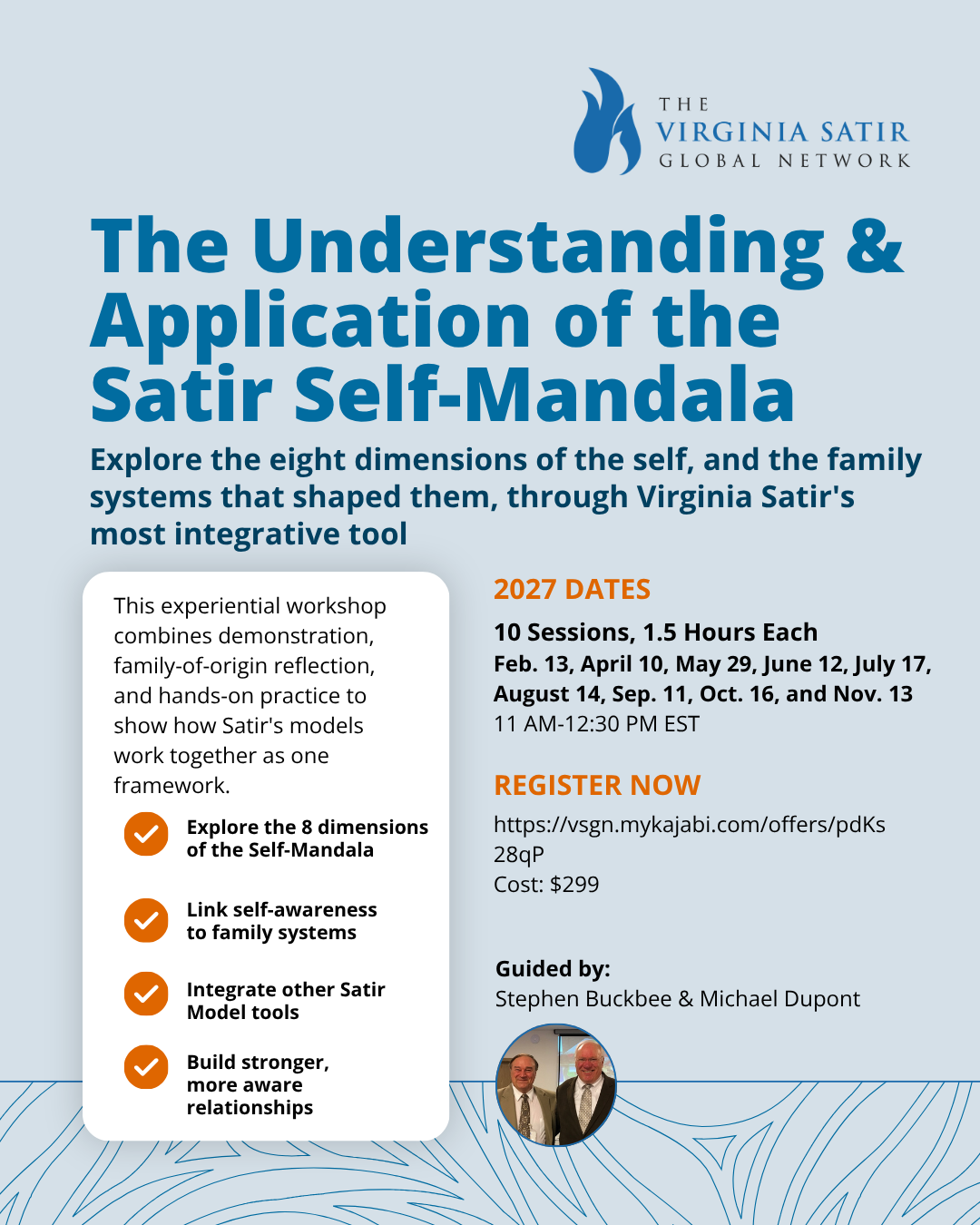
Certified Satir Therapists are further developed through guided mentorship with experienced Satir practitioners. Mentors help candidates implement STST in clinical practice through individual or group consultation. The Learning Center will provide the applicant with recommended Satir experienced mentors.
-
Minimum of 15 hours of individual mentoring (45-minute sessions) or 20 hours of group mentoring (50–90 minute sessions)
-
Review and approval of four video segments demonstrating STST application
-
Case presentations, case study review and conceptualization, treatment plan development
-
Payment of mentor fees directly to mentor
-
Mentor will provide feedback to the Satir Global Learning Center regarding the readiness of the applicant for certification.
- Administrative Fee: $540.00 (one-time, payable to VSGN at time of Certification Track acceptance into the certification program).
- Course Fees: Tuition and fees for C1 – C9 & 18 additional hours chosen from the Learning Center Catalog.
- Mentoring Fees: Vary by mentor and modality (individual/group). Candidates are responsible for arranging payment directly with their chosen mentor.
- Clinical Membership Fee: $200 Clinical membership in The Virginia Satir Global Network® must be maintained annually upon being awarded certification to be listed on the Satir Referral Network on the VSGN website.
All certification requirements, including course work, video review and mentoring hours must be complete within three years of acceptance into the program